Monday, June 14, 2010

112th Independence Day Commemoration

The 112th Independence Day Celebrations

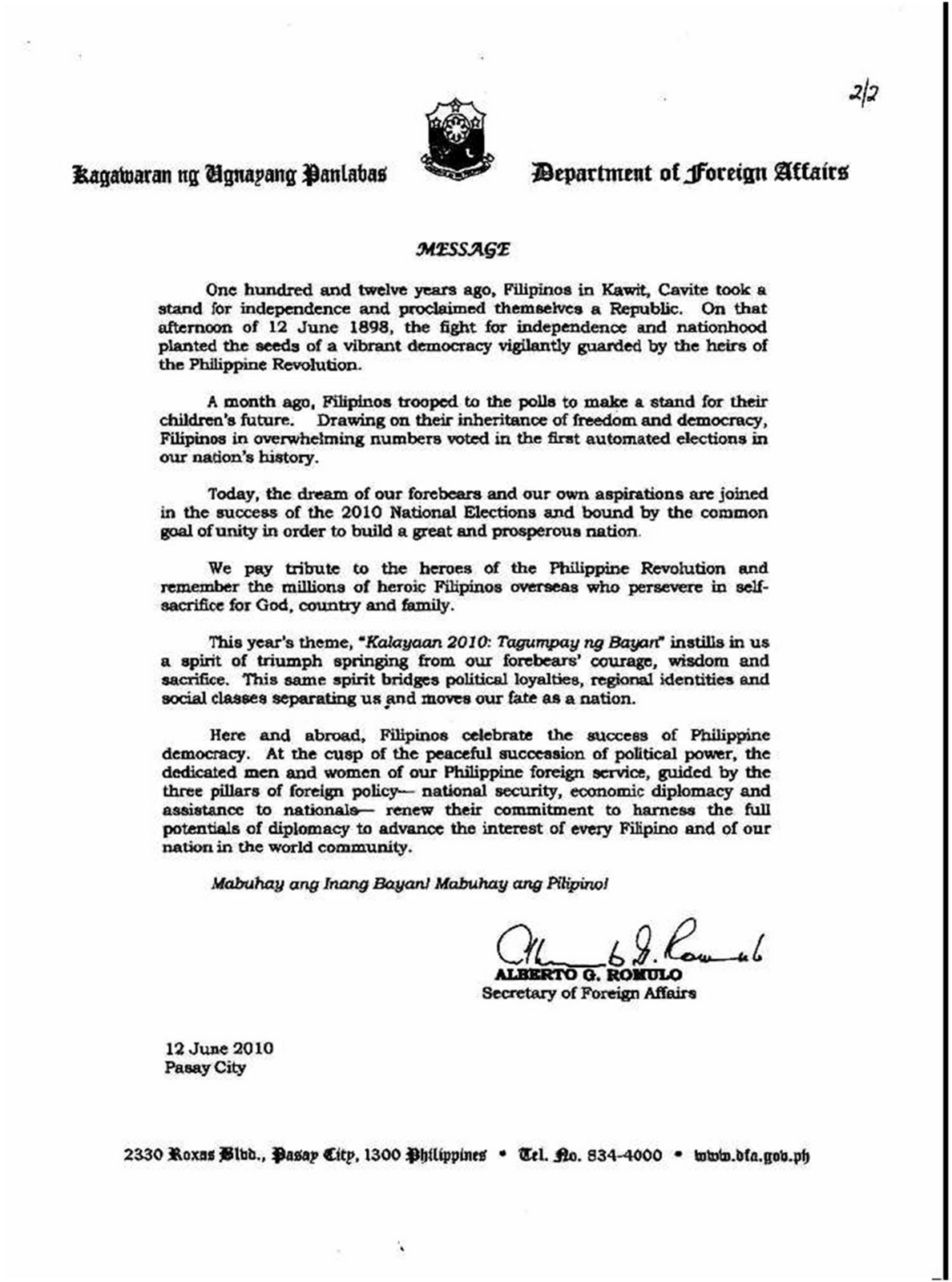
June 12, 2010 marked the 112th Philippine Independence Day. It was a low-keyed celebration compared to last year which was marked with a month-long preparation and activities.

A Holy Mass was officiated by Msgr Jean for the Filipino people held at The Nunciature at 7:30 in the morning. The mass was attended by the embassy staff led by Con-General Alex V. Lamadrid joined by some OFWs. After the Mass, the Filipinos proceeded to the Philippine Embassy to join the others who were already there. Ambassadors from some ASEAN countries attended the event.

The flag-raising ceremony was held. A short welcome address by Con-Gen Lamadrid was duly rendered followed by the customary Christian and Muslim prayers after which everybody was requested to partake in the Filipino breakfast prepared by the embassy.

Shown below: Con-Gen. Alex V. Lamadrid while welcoming the guests and the community, Doy Abrillo and Alex Emam for the prayers...


Tuesday, June 8, 2010

CMA DIRECTOR ELLENE SANA

CMA Director Ellene Sana, the front-runner in our struggle for the lifting of the travel ban to Nigeria as imposed by GMA's administration, is now fighting for the domestic workers' rights. These domestic workers are often maligned/abused by their employers especially in the Middle East.
"Sana lamented that domestic work has not been fully and widely recognized as work; domestic workers have not been covered by labor laws that protect and promote their rights, welfare, and dignity."


ILO urged to work for standard guidelines on domestic help
By Jerome Aning
Philippine Daily Inquirer First Posted 22:38:00 06/06/2010

MANILA, Philippines -- A Filipino woman leading an Asian migrants group called on the International Labor Organization to pressure governments, as well as workers and employers group to work for a convention setting international standards for domestic helpers.
“A definitive, coherent, and comprehensive instrument is needed to clearly establish minimum standards and rights for all domestic workers as workers,” Migrants Forum Asia executive committee chair Ellene Sana said in a speech on June 3 to delegates to the ongoing 99th International Labor Conference in Geneva, Switzerland.
Sana lamented that domestic work has not been fully and widely recognized as work; domestic workers have not been covered by labor laws that protect and promote their rights, welfare, and dignity.
“Despite the significant contributions of domestic workers to their households and employers’ families, to communities and countries (both of origin and destination), and to the industries and economies in which they selflessly invest their time, skills, sweat and tears, these domestic workers have yet to enjoy the recognition they have so long deserved,” she said
She added domestics have been in one of the “most insecure of environments where work is often casual, temporary, sub-contracted or informal, where benefits and conditions are not standardized – no minimum wage, no set working hours, no social security, and no provisions for occupational safety – and where there is little, if any, labor and human rights protection.”
Sana, who chairs the Quezon City-based Center for Migrants Advocacy, said domestics’ work should be valued and respected as one of the essential job sectors that contribute to society’s productivity and development.
“Their conditions of work must be on a par with other job categories including valid work contracts and visas, social mobility, job security and collective labor rights,” she said.
Sana said there should be a separate international pact on domestic workers because the 1979 UN Convention on the Elimination of all Forms of Discrimination against Women and the 1990 UN Convention on the Protection of the Rights of All Migrant Workers and Members of Their Families only provided partial coverage of domestics’ rights.
MFA, along with the Asian Migrant Domestic Workers’ Alliance and the International Working Group for Domestic Workers, is pushing for an ILO Convention on Domestic Work that will significantly contribute to the reduction of slavery-like conditions, abuse, violence, exploitation, inequality, and discrimination against women and domestic workers.
“It will help reduce the worst forms of child labor, the stigmatization and criminalization of migrant domestic workers including undocumented workers, and racial and ethnic discrimination,” Sana explained.
The proposed convention would also help provide the minimum basis and standards for the recognition of the status and rights of domestic workers as workers.
“Domestic work is work and that domestic workers must be treated with respect and dignity,” she added, saying domestics themselves should participate in the crafting of the convention.
According to a United Nations estimate, a vast majority of the 60 million migrant workers in Asia are women and are predominantly engaged in domestic work. Most of them come from Indonesia, the Philippines, Bangladesh, Nepal, Sri Lanka, India, Myanmar, Thailand, and Laos and are employed in Malaysia, Hong Kong, Singapore, Thailand, Macau, India, Taiwan, and the Middle East.
Sana said domestic workers were driven to engage in domestic work for various reasons – most commonly by the endemic poverty in their homes that made it impossible for them to have job opportunities in other industries or fields of work.
Most of these women left their own countries in the hope of earning better incomes abroad, she said.

Monday, June 7, 2010

Celebrations

HAPPY BIRTHDAY, RAMI!!!

Although every day IS ALWAYS a special day, SUNDAY is always MOST special – rain or no rain. Last Sunday Rami celebrated his birthday. Doting parents, Nonits and Otie Barraquias and of course Nino, the elder brother prepared a special Paella and cake; Maris with her Cassava cake (eyed with serious ‘greed’ by everybody); roasted ram, mga chichiryas and most of all – ang ginataang sitaw ni John na may halong dilis! Si JT naging food conscious – pinya at pakwan ang dala.

The rain couldn’t dampen the chatter and the laughter of friends and cheerful wishes not only to the celebrant but also to everyone by everyone. After the prayer before meals, the tribe dealt with the food with much gusto! (The prayer was answered: let the food be delicious - and so it was.)

THE FINALE......ACTION STARS at their most convincing ACTS! (starring Gel and Rami)


Actions caught on camera:


THE FINALE......ACTION STARS at their most convincing ACTS!


Friday, June 4, 2010

99th Session of the International Labour Conference, Geneva, 3 June 2010

SPEECH DELIVERED BY CMA DIRECTOR ELLENE SANA


MFA STATEMENT* AT THE SECOND SESSION

OF THE DOMESTIC WORKERS’ COMMITTEE

99th Session of the International Labour Conference, Geneva, 3 June 2010


A vast majority of the UN-estimated 60 million migrant workers in Asia are women and are predominantly engaged in domestic work. Most of them come from Indonesia, the Philippines, Bangladesh, Nepal, Sri Lanka, India, Myanmar, Thailand, and Lao PDR and are employed in Malaysia, Hong Kong, Singapore, Thailand, Macau, India, Taiwan, and the Middle East. Many more Asian women are employed as domestic workers elsewhere in the world.

Domestic workers are driven to engage in domestic work for various reasons – most common of which is the endemic poverty in their homes that makes it impossible for them to have job opportunities in other industries or fields of work. Most of these women are driven out of their own countries in the hope of earning better incomes abroad while they provide domestic services to foreign employers. This puts domestic workers in one of the most insecure of environments where work is often casual, temporary, sub-contracted or informal, where benefits and conditions are not standardized – no minimum wage, no set working hours, no social security, and no provisions for occupational safety – and where there is little, if any, labour and human rights protection.

Furthermore, despite the significant contributions of domestic workers to their households and employers’ families, to communities and countries (both of origin and destination), and to the industries and economies in which they selflessly invest their time, skills, sweat and tears, these domestic workers have yet to enjoy the recognition they have so long deserved. Domestic work is yet to be fully and widely recognised as work: domestic workers are yet to be covered by labour laws that protect and promote their rights, welfare, and dignity. Their work should be valued and respected as one of the essential job sectors that contribute to society’s productivity and development; and that therefore, their conditions of work must be on a par with other job categories including valid work contracts and visas, social mobility, job security and collective labour rights.

A critical step for the International Campaign for the Rights and Recognition of Domestic Workers is the establishment of international labour and human rights standards specific to domestic workers. These will help provide the minimum basis and standards for the recognition of the status and rights of domestic workers as workers.

The existing core UN instruments and the fundamental ILO labour standards can be and are being used by domestic workers’ groups and advocates in asserting the rights and status of domestic workers as workers. Foremost among these are CEDAW and the Migrant Workers’ Convention. However, all of these provide only partial coverage of domestic workers’ rights. A definitive, coherent, and comprehensive instrument is needed to clearly establish minimum standards and rights for ALL domestic workers as workers.


Migrant Forum in Asia (MFA), Asian Migrant Domestic Workers’ Alliance (ADWA), and the International Working Group for Domestic Workers (IWG-DW), believe an ILO Convention on Domestic Work will significantly contribute to the reduction of slavery-like conditions, abuse, violence, exploitation, inequality, and discrimination against women and domestic workers. It will help reduce the worst forms of child labour, the stigmatization and criminalization of migrant domestic workers including undocumented workers, and racial and ethnic discrimination.

At this critical juncture where the fate of the proposed ILO Convention rests in the hands of governments, workers’ groups, and employers’ groups, we are encouraged by the common sentiment of the tripartite partners. Certainly, we are in agreement that domestic work is work and that domestic workers must be treated with respect and dignity.

We appreciate the tripartite’s recognition of the urgent need to have a flexible but robust and effective instrument that protects domestic workers. We believe that this takes the form of a Convention Supplemented by Recommendations.

Finally, we emphasize the urgency of having domestic workers themselves centrally and critically involved in this process otherwise, the non-recognition and marginalization of domestic workers will be reinforced. We recognize the domestic workers who are with us today who will be directly affected by what is done or not done in their name in this 99th session of the ILC. We stand in solidarity with the domestic workers who cannot be physically present here but who engaged in the various national and regional processes to ensure their voices are heard and their demands for rights and recognition are considered, recognized, respected, and protected.

We are all eagerly anticipating a historic moment unfold in this year’s ILC.


*Delivered for MFA by Miss Ellene Sana, Chairperson of the MFA Executive Committee


ellene a. sana
Center for Migrant Advocacy Philippines
72-C Matahimik Street, Teachers’ Village
Quezon City, Philippines
Email: cmaphils@pldtdsl.net; URL: www.pinoy-abroad.net
Telefax: +632 4330684; Telephone: +632 920 5003; Cellphone: +63 928 795 2222

Arroyo hears high praise at DFA

Romulo on Arroyo
She cares about the life of every single
Filipino, Romulo said, “thus she worked hard to have death sentences commuted,”
referring to Filipino workers in overseas jails.

Arroyo hears high praise at DFA
Philippine Daily Inquirer First Posted 03:38:00 06/02/2010
MANILA, Philippines—Foreign Secretary Alberto Romulo Tuesday credited President Gloria Macapagal-Arroyo’s “outstanding performance” as the country’s chief diplomat and as a major player in the international field for the Philippines’ standing in the world community.
Speaking at a retrospective seminar during the Department of Foreign Affair’s 112th anniversary, Romulo praised the President for pushing a people-centered foreign policy.
“In the field of foreign relations of which the President is the architect, her performance has been outstanding. Under her leadership, much has been accomplished,” he said.
Ms Arroyo was at the seminar but did not address the participants. Afterward, she was presented with three coffee table books. Presidential awards and citations were also handed out to 44 individuals and groups that were instrumental to the DFA’s success.
Romulo said the Arroyo administration made sure the global Filipino got the best in consular services with the adoption of the electronic ePassport, the construction of a new consular building and the implementation of the Overseas Absentee Voting Law.
She cares about the life of every single Filipino, Romulo said, “thus she worked hard to have death sentences commuted,” referring to Filipino workers in overseas jails.
In international forums, he said Ms Arroyo had no peer.
“Her fellow heads of state listened to her. Listening to the debates, my fellow foreign ministers would approach me and express how impressed they were.”
In the field of national security, Romulo said Ms Arroyo made sure Philippine sovereignty and territory were respected through the Baselines Law.
She made possible the signing of the Declaration of Conduct in the South China Sea; the shift to an all-out peace policy in Mindanao; pushed for interfaith initiatives; strengthened bilateral and multilateral relations; and worked for a nuclear-free world with the Philippines’ presidency of the recent Nuclear Non-Proliferation Treaty Review Conference in New York.
Romulo said Ms Arroyo’s international trips reaped many benefits. Through her 10 years of economic diplomacy, he said the country was able to attract significant investments and development assistance, particularly for the business process outsourcing sector.
“Indeed the DFA owes the President a lot,” Romulo said.
The seminar highlighted the DFA’s achievements in the “Eight Realities of Philippine Foreign Policy” set by the Arroyo administration in 2001, with testimonials by individuals who affirmed the DFA’s success in these aspects. Cynthia D. Balana

Wednesday, May 12, 2010

44 groups likely to get seats in Congress: ABS-CBN/Pulse Asia exit poll (AKBAYAN - among them)

44 groups likely to get seats in Congress: ABS-CBN/Pulse Asia exit poll

By Lilita Balane, abs-cbnNEWS.com/Newsbreak

Posted at 05/12/2010 5:33 PM | Updated as of 05/12/2010 5:33 PM

MANILA, Philippines—Of the 187 organizations that participated in the party-list election, 44 groups are likely to get seats in the House of Representatives, the results of an ABS-CBN/Pulse Asia exit poll showed on Wednesday.

Applying the seat allocation formula set by the Supreme Court in its April 2009 decision, these groups will be able to send 57 nominees to the 15th Congress.

The exit poll, conducted by Pulse Asia for ABS-CBN, interviewed 7,296 voters and has an error of margin of +/-1.8.

AkoBicol (AKB) and Senior Citizens led the ABS-CBN/Pulse Asia nationwide survey on party-list preference, receiving 5.11% and 4.54% of the votes, respectively. Each of them may get 3 seats.

Based on the SC formula, the 57 party-list seats in the House would be granted to groups which will obtain 2% of the votes. The rest will be allocated to the leading groups and to the next in rank until all the seats are distributed. A party-list group may occupy a maximum of 3 seats.

AKB's nominees are lawyers Christopher Co, Rodel Batocabe, and Alfredo Garbin Jr.

In the last election, Senior Citizens occupied only 1 seat in the House, sending its representative and first nominee Godofredo Arquiza. He might return to Congress with 2 more nominees, businessman David Kho and Francisco Datol Jr.

Nine incumbent groups might have the chance to bring 2 representatives each: Akbayan (3.72%), Abono (2.99%), Gabriela (3.03%), COOP-NATTCO (2.67%), Butil (2.01%), and AnWaray (2.11%) might retain their seats in the House.

Two other incumbent groups, Bayan Muna (3.03%) and Buhay (4.07%), that currently occupy 3 seats each, might only get 2 seats each this time.

Newly-accredited 1-CARE, which might get 2 seats, has nominated Michael Angelo Rivera and electric cooperative official Salvador Cabaluna III.

One seat for 33 groups

Thirty-three party-list groups might receive 1 seat each. They are:

* ABAMIN
* LPGMA
* A Teacher
* CIBAC
* KAKUSA

* ABC
* YACAP
* APEC
* AAMBIS-OWA
* ANAKPAWIS

* ALIF
* ANG KASANGGA
* AGAP
* KABATAAN
* AGBIAG

* ANAD
* AVE
* TUCP
* BH
* AMIN

* AMANA
* KALINGA
* AG
* ABS
* ACT Teachers

* ANAK
* 1 ANG PAMILYA
* AGHAM
* ALAGAD
* ALAY BUHAY

* PBA
* APELA
* 1-UTAK

Fourteen of these groups are currently represented in Congress.

Rep. Mikey again?

Pampanga Rep. Juan Miguel “Mikey” Arroyo, son of President Arrroyo, might secure his place in the House. He is the first nominee of Ang Galing Pinoy or AG, a group representing security guards.

Other prominent nominees who might seat in Congress are former energy secretary Angelo Reyes (1-UTAK, ) Quezon City District 1 councilor Bernadette Herrera-Dy (BH), and former Cagayan congressman Patricio Antonio (AGBIAG).

APELA, on the other hand, may not be able to send its representative, former Bureau of Jail Management and Penology chief Arturo Alit. The Commission on Elections refused to accredit APELA for the party list, a decision upheld by the Supreme Court only after the ballots that included the group's name had been printed. (abs-cbnNews.com/Newsbreak)

Tuesday, May 11, 2010

OAV - MAY 10, 2010

FAMILY DAY - Also a call for OAV

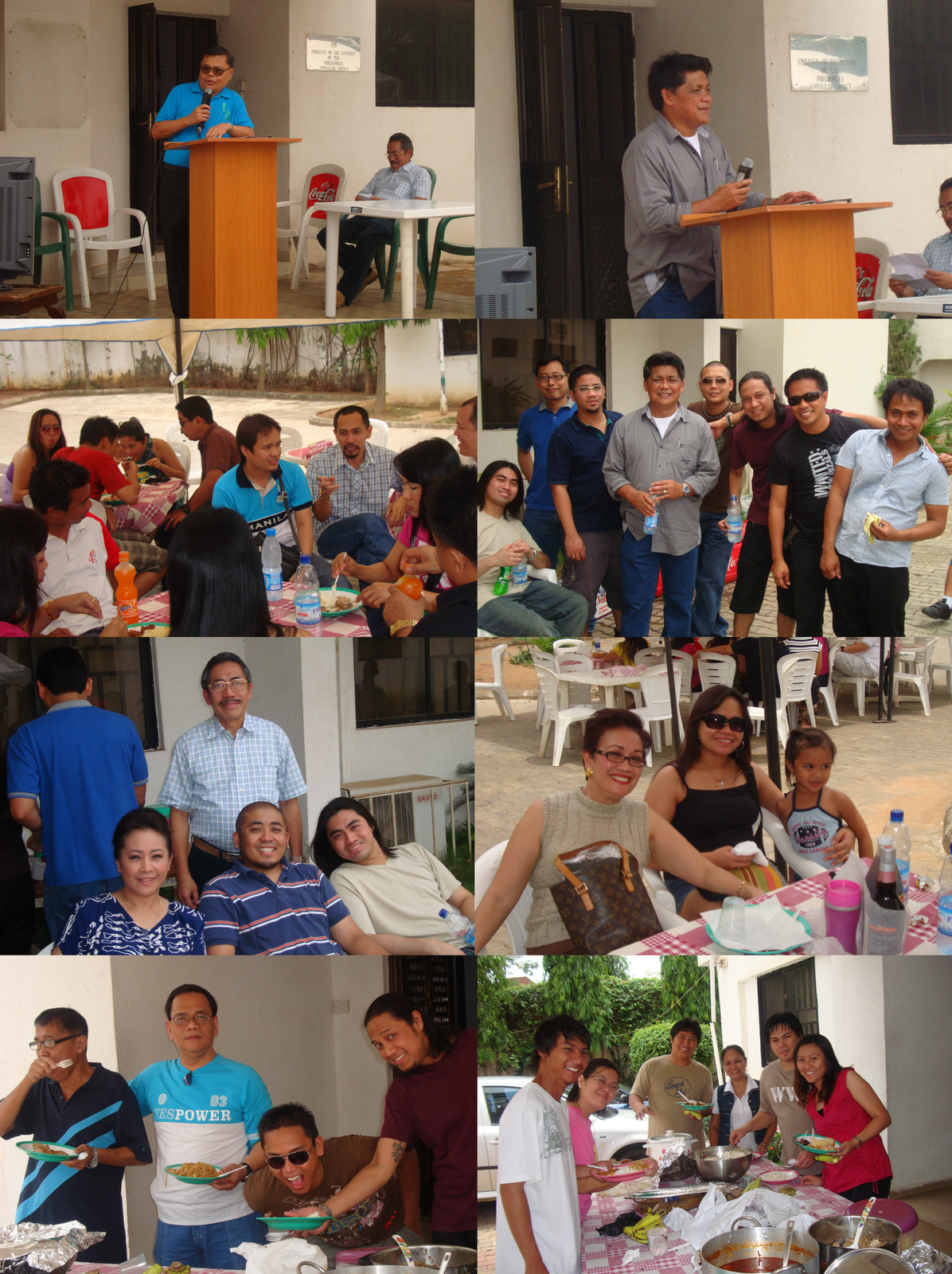
The Filipino Community in Abuja, Nigeria made the last call for OAV during the Family Day Celebrations held last May 2.Pictures showed Consul Garangan reminding the OFWs in Abuja to vote. Architect Benjamin Nadado, the President of Pusong Pinoy Association likewise called on registered voters to exercise this right. The associations' election was also held the same day. The replacement of Cocoy Laurel (the embassy's Finance Officer who will be transferred to Turkey) was also introduced.


________________________________________________________________________

OVERSEAS ABSEENTEE VOTING

Monday May 10, 2010 at exactly 12:00 noon (7:00pm Philippine time), the Philippine Embassy conducted the ballot counting. Against the 'intent gaze of Jose Rizal,' the watchers and embassy officials stationed themselves in the conference hall of the Phillipine Embassy.

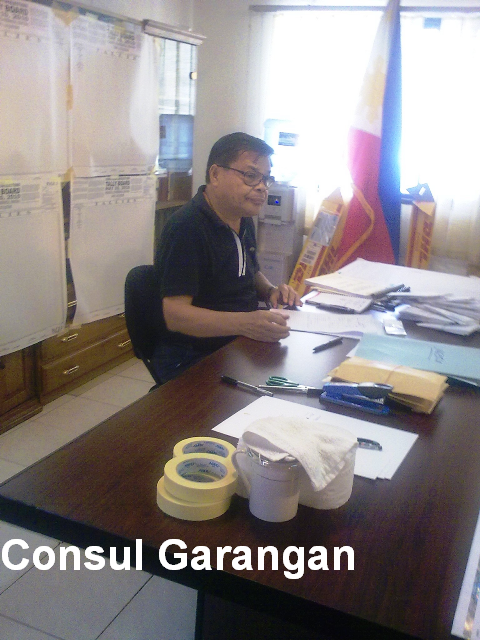
Consul Garangan started the proceedings as shown below:


Brenda Mabansag of the Philippine Embassy writes on the Tally sheet pasted on the board while Alex Imam tallies on the sheet spread on the table. Observers include PPA President Benjamin Nadado, PPA Treasurer Lito Nucum, PPA Board Secretary Vangie Novio and Malou Glaznig.


The counting was keenly observed.


The tally sh
eet for the first four ballots counted is shown below.