Monday, June 7, 2010

Celebrations

HAPPY BIRTHDAY, RAMI!!!

Although every day IS ALWAYS a special day, SUNDAY is always MOST special – rain or no rain. Last Sunday Rami celebrated his birthday. Doting parents, Nonits and Otie Barraquias and of course Nino, the elder brother prepared a special Paella and cake; Maris with her Cassava cake (eyed with serious ‘greed’ by everybody); roasted ram, mga chichiryas and most of all – ang ginataang sitaw ni John na may halong dilis! Si JT naging food conscious – pinya at pakwan ang dala.

The rain couldn’t dampen the chatter and the laughter of friends and cheerful wishes not only to the celebrant but also to everyone by everyone. After the prayer before meals, the tribe dealt with the food with much gusto! (The prayer was answered: let the food be delicious - and so it was.)

THE FINALE......ACTION STARS at their most convincing ACTS! (starring Gel and Rami)


Actions caught on camera:


THE FINALE......ACTION STARS at their most convincing ACTS!


Friday, June 4, 2010

99th Session of the International Labour Conference, Geneva, 3 June 2010

SPEECH DELIVERED BY CMA DIRECTOR ELLENE SANA


MFA STATEMENT* AT THE SECOND SESSION

OF THE DOMESTIC WORKERS’ COMMITTEE

99th Session of the International Labour Conference, Geneva, 3 June 2010


A vast majority of the UN-estimated 60 million migrant workers in Asia are women and are predominantly engaged in domestic work. Most of them come from Indonesia, the Philippines, Bangladesh, Nepal, Sri Lanka, India, Myanmar, Thailand, and Lao PDR and are employed in Malaysia, Hong Kong, Singapore, Thailand, Macau, India, Taiwan, and the Middle East. Many more Asian women are employed as domestic workers elsewhere in the world.

Domestic workers are driven to engage in domestic work for various reasons – most common of which is the endemic poverty in their homes that makes it impossible for them to have job opportunities in other industries or fields of work. Most of these women are driven out of their own countries in the hope of earning better incomes abroad while they provide domestic services to foreign employers. This puts domestic workers in one of the most insecure of environments where work is often casual, temporary, sub-contracted or informal, where benefits and conditions are not standardized – no minimum wage, no set working hours, no social security, and no provisions for occupational safety – and where there is little, if any, labour and human rights protection.

Furthermore, despite the significant contributions of domestic workers to their households and employers’ families, to communities and countries (both of origin and destination), and to the industries and economies in which they selflessly invest their time, skills, sweat and tears, these domestic workers have yet to enjoy the recognition they have so long deserved. Domestic work is yet to be fully and widely recognised as work: domestic workers are yet to be covered by labour laws that protect and promote their rights, welfare, and dignity. Their work should be valued and respected as one of the essential job sectors that contribute to society’s productivity and development; and that therefore, their conditions of work must be on a par with other job categories including valid work contracts and visas, social mobility, job security and collective labour rights.

A critical step for the International Campaign for the Rights and Recognition of Domestic Workers is the establishment of international labour and human rights standards specific to domestic workers. These will help provide the minimum basis and standards for the recognition of the status and rights of domestic workers as workers.

The existing core UN instruments and the fundamental ILO labour standards can be and are being used by domestic workers’ groups and advocates in asserting the rights and status of domestic workers as workers. Foremost among these are CEDAW and the Migrant Workers’ Convention. However, all of these provide only partial coverage of domestic workers’ rights. A definitive, coherent, and comprehensive instrument is needed to clearly establish minimum standards and rights for ALL domestic workers as workers.


Migrant Forum in Asia (MFA), Asian Migrant Domestic Workers’ Alliance (ADWA), and the International Working Group for Domestic Workers (IWG-DW), believe an ILO Convention on Domestic Work will significantly contribute to the reduction of slavery-like conditions, abuse, violence, exploitation, inequality, and discrimination against women and domestic workers. It will help reduce the worst forms of child labour, the stigmatization and criminalization of migrant domestic workers including undocumented workers, and racial and ethnic discrimination.

At this critical juncture where the fate of the proposed ILO Convention rests in the hands of governments, workers’ groups, and employers’ groups, we are encouraged by the common sentiment of the tripartite partners. Certainly, we are in agreement that domestic work is work and that domestic workers must be treated with respect and dignity.

We appreciate the tripartite’s recognition of the urgent need to have a flexible but robust and effective instrument that protects domestic workers. We believe that this takes the form of a Convention Supplemented by Recommendations.

Finally, we emphasize the urgency of having domestic workers themselves centrally and critically involved in this process otherwise, the non-recognition and marginalization of domestic workers will be reinforced. We recognize the domestic workers who are with us today who will be directly affected by what is done or not done in their name in this 99th session of the ILC. We stand in solidarity with the domestic workers who cannot be physically present here but who engaged in the various national and regional processes to ensure their voices are heard and their demands for rights and recognition are considered, recognized, respected, and protected.

We are all eagerly anticipating a historic moment unfold in this year’s ILC.


*Delivered for MFA by Miss Ellene Sana, Chairperson of the MFA Executive Committee


ellene a. sana
Center for Migrant Advocacy Philippines
72-C Matahimik Street, Teachers’ Village
Quezon City, Philippines
Email: cmaphils@pldtdsl.net; URL: www.pinoy-abroad.net
Telefax: +632 4330684; Telephone: +632 920 5003; Cellphone: +63 928 795 2222

Arroyo hears high praise at DFA

Romulo on Arroyo
She cares about the life of every single
Filipino, Romulo said, “thus she worked hard to have death sentences commuted,”
referring to Filipino workers in overseas jails.

Arroyo hears high praise at DFA
Philippine Daily Inquirer First Posted 03:38:00 06/02/2010
MANILA, Philippines—Foreign Secretary Alberto Romulo Tuesday credited President Gloria Macapagal-Arroyo’s “outstanding performance” as the country’s chief diplomat and as a major player in the international field for the Philippines’ standing in the world community.
Speaking at a retrospective seminar during the Department of Foreign Affair’s 112th anniversary, Romulo praised the President for pushing a people-centered foreign policy.
“In the field of foreign relations of which the President is the architect, her performance has been outstanding. Under her leadership, much has been accomplished,” he said.
Ms Arroyo was at the seminar but did not address the participants. Afterward, she was presented with three coffee table books. Presidential awards and citations were also handed out to 44 individuals and groups that were instrumental to the DFA’s success.
Romulo said the Arroyo administration made sure the global Filipino got the best in consular services with the adoption of the electronic ePassport, the construction of a new consular building and the implementation of the Overseas Absentee Voting Law.
She cares about the life of every single Filipino, Romulo said, “thus she worked hard to have death sentences commuted,” referring to Filipino workers in overseas jails.
In international forums, he said Ms Arroyo had no peer.
“Her fellow heads of state listened to her. Listening to the debates, my fellow foreign ministers would approach me and express how impressed they were.”
In the field of national security, Romulo said Ms Arroyo made sure Philippine sovereignty and territory were respected through the Baselines Law.
She made possible the signing of the Declaration of Conduct in the South China Sea; the shift to an all-out peace policy in Mindanao; pushed for interfaith initiatives; strengthened bilateral and multilateral relations; and worked for a nuclear-free world with the Philippines’ presidency of the recent Nuclear Non-Proliferation Treaty Review Conference in New York.
Romulo said Ms Arroyo’s international trips reaped many benefits. Through her 10 years of economic diplomacy, he said the country was able to attract significant investments and development assistance, particularly for the business process outsourcing sector.
“Indeed the DFA owes the President a lot,” Romulo said.
The seminar highlighted the DFA’s achievements in the “Eight Realities of Philippine Foreign Policy” set by the Arroyo administration in 2001, with testimonials by individuals who affirmed the DFA’s success in these aspects. Cynthia D. Balana

Wednesday, May 12, 2010

44 groups likely to get seats in Congress: ABS-CBN/Pulse Asia exit poll (AKBAYAN - among them)

44 groups likely to get seats in Congress: ABS-CBN/Pulse Asia exit poll

By Lilita Balane, abs-cbnNEWS.com/Newsbreak

Posted at 05/12/2010 5:33 PM | Updated as of 05/12/2010 5:33 PM

MANILA, Philippines—Of the 187 organizations that participated in the party-list election, 44 groups are likely to get seats in the House of Representatives, the results of an ABS-CBN/Pulse Asia exit poll showed on Wednesday.

Applying the seat allocation formula set by the Supreme Court in its April 2009 decision, these groups will be able to send 57 nominees to the 15th Congress.

The exit poll, conducted by Pulse Asia for ABS-CBN, interviewed 7,296 voters and has an error of margin of +/-1.8.

AkoBicol (AKB) and Senior Citizens led the ABS-CBN/Pulse Asia nationwide survey on party-list preference, receiving 5.11% and 4.54% of the votes, respectively. Each of them may get 3 seats.

Based on the SC formula, the 57 party-list seats in the House would be granted to groups which will obtain 2% of the votes. The rest will be allocated to the leading groups and to the next in rank until all the seats are distributed. A party-list group may occupy a maximum of 3 seats.

AKB's nominees are lawyers Christopher Co, Rodel Batocabe, and Alfredo Garbin Jr.

In the last election, Senior Citizens occupied only 1 seat in the House, sending its representative and first nominee Godofredo Arquiza. He might return to Congress with 2 more nominees, businessman David Kho and Francisco Datol Jr.

Nine incumbent groups might have the chance to bring 2 representatives each: Akbayan (3.72%), Abono (2.99%), Gabriela (3.03%), COOP-NATTCO (2.67%), Butil (2.01%), and AnWaray (2.11%) might retain their seats in the House.

Two other incumbent groups, Bayan Muna (3.03%) and Buhay (4.07%), that currently occupy 3 seats each, might only get 2 seats each this time.

Newly-accredited 1-CARE, which might get 2 seats, has nominated Michael Angelo Rivera and electric cooperative official Salvador Cabaluna III.

One seat for 33 groups

Thirty-three party-list groups might receive 1 seat each. They are:

* ABAMIN
* LPGMA
* A Teacher
* CIBAC
* KAKUSA

* ABC
* YACAP
* APEC
* AAMBIS-OWA
* ANAKPAWIS

* ALIF
* ANG KASANGGA
* AGAP
* KABATAAN
* AGBIAG

* ANAD
* AVE
* TUCP
* BH
* AMIN

* AMANA
* KALINGA
* AG
* ABS
* ACT Teachers

* ANAK
* 1 ANG PAMILYA
* AGHAM
* ALAGAD
* ALAY BUHAY

* PBA
* APELA
* 1-UTAK

Fourteen of these groups are currently represented in Congress.

Rep. Mikey again?

Pampanga Rep. Juan Miguel “Mikey” Arroyo, son of President Arrroyo, might secure his place in the House. He is the first nominee of Ang Galing Pinoy or AG, a group representing security guards.

Other prominent nominees who might seat in Congress are former energy secretary Angelo Reyes (1-UTAK, ) Quezon City District 1 councilor Bernadette Herrera-Dy (BH), and former Cagayan congressman Patricio Antonio (AGBIAG).

APELA, on the other hand, may not be able to send its representative, former Bureau of Jail Management and Penology chief Arturo Alit. The Commission on Elections refused to accredit APELA for the party list, a decision upheld by the Supreme Court only after the ballots that included the group's name had been printed. (abs-cbnNews.com/Newsbreak)

Tuesday, May 11, 2010

OAV - MAY 10, 2010

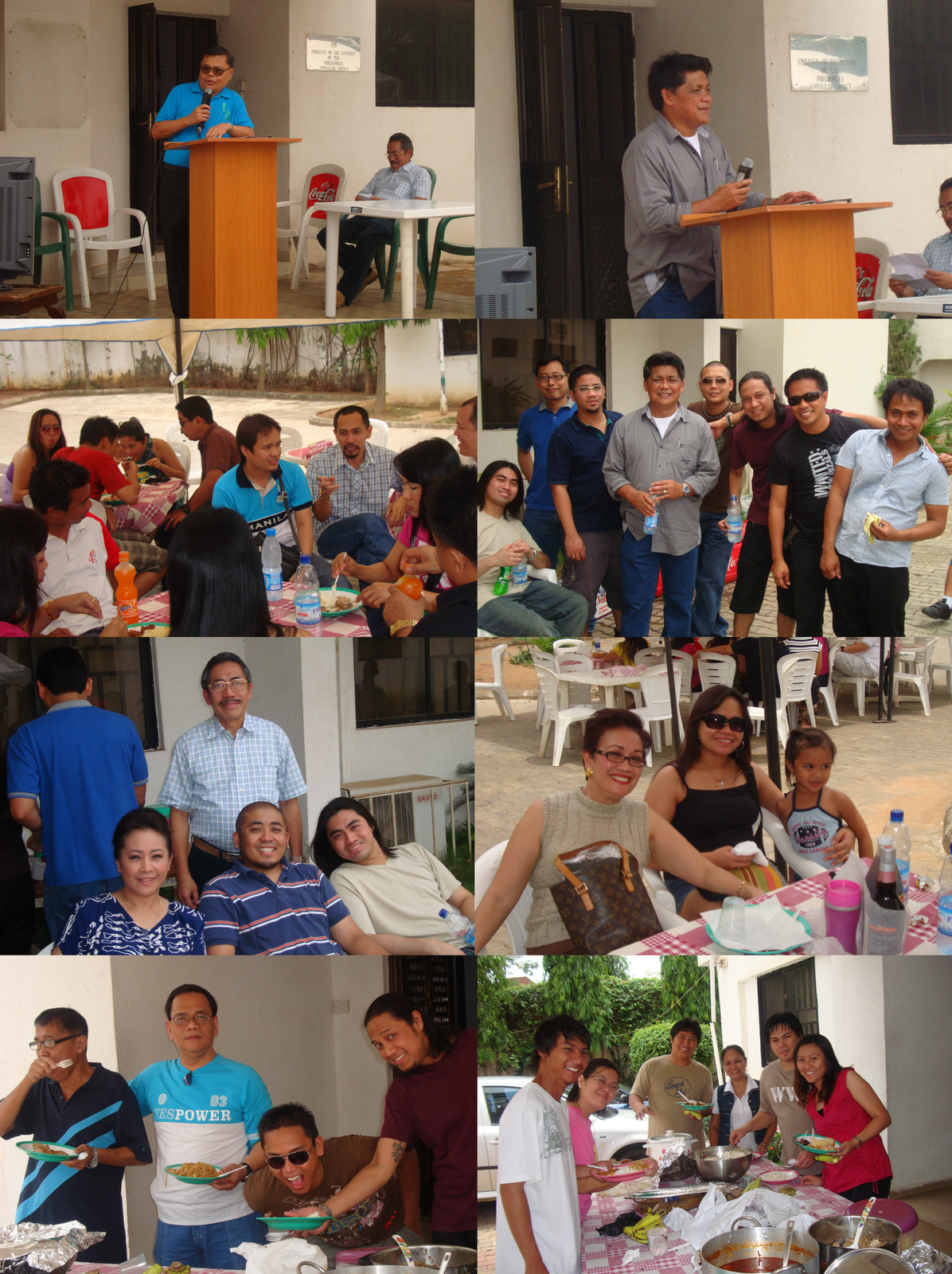
FAMILY DAY - Also a call for OAV

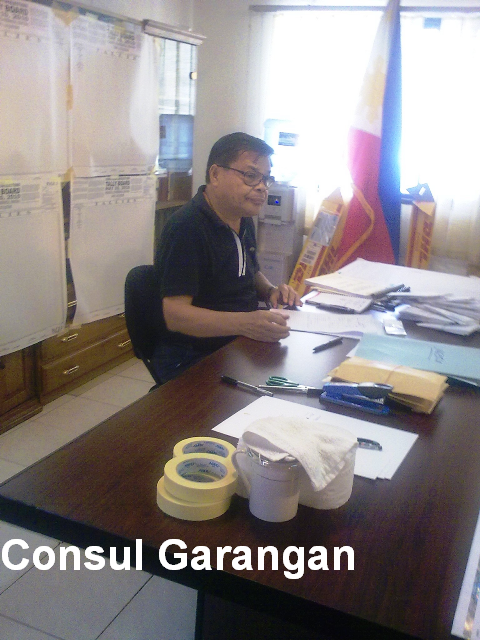
The Filipino Community in Abuja, Nigeria made the last call for OAV during the Family Day Celebrations held last May 2.Pictures showed Consul Garangan reminding the OFWs in Abuja to vote. Architect Benjamin Nadado, the President of Pusong Pinoy Association likewise called on registered voters to exercise this right. The associations' election was also held the same day. The replacement of Cocoy Laurel (the embassy's Finance Officer who will be transferred to Turkey) was also introduced.


________________________________________________________________________

OVERSEAS ABSEENTEE VOTING

Monday May 10, 2010 at exactly 12:00 noon (7:00pm Philippine time), the Philippine Embassy conducted the ballot counting. Against the 'intent gaze of Jose Rizal,' the watchers and embassy officials stationed themselves in the conference hall of the Phillipine Embassy.

Consul Garangan started the proceedings as shown below:


Brenda Mabansag of the Philippine Embassy writes on the Tally sheet pasted on the board while Alex Imam tallies on the sheet spread on the table. Observers include PPA President Benjamin Nadado, PPA Treasurer Lito Nucum, PPA Board Secretary Vangie Novio and Malou Glaznig.


The counting was keenly observed.


The tally sh
eet for the first four ballots counted is shown below.

Saturday, May 8, 2010

HAPPY MOTHER'S DAY

HAPPY MOTHER'S DAY

Although it is a basic fact that every day IS Mother’s Day, this special day is set aside for Mothers, the second Sunday in May.

It’s the day when we get to honor our mothers and recognize the amazing job that they do –

Mother’s Day.

The greatness of a MOTHER can never be measured. She is the individual that nourishes, champions, sustains and supports us.

She works for us day and night.

Her love is unlimited.

She helps and guides us at each and every step.
She is the most precious present given to us by God.

HURRAH TO ALL MOTHERS !

TO ALL MARRIED OFWs (men):


Here’s to your wife – the MOTHER of your children –

May she have the

GENUINE LOVE,

HAPPINESS,

PROSPERITY

and

WELL-BEING

she rightfully deserves!

Friday, May 7, 2010

To the Family of Late President UMARU YAR A’DUA and THE NIGERIAN PEOPLE


6th May, 2010

To the Family of Late President UMARU YAR A’DUA and THE NIGERIAN PEOPLE

With deepest regret and sorrow, we, the Executive Officers, Board of Trustees and members of PUSONG PINOY ASSOCIATION in Abuja FCT, Nigeria, wish to send through this letter, our sympathies and condolence on the passing away of your dear and humble husband, father, friend and Commander In-Chief, President UMARU YAR A’DUA. He was a symbol of unity, honesty and good governance by example and deeds. Indeed, he was an exemplary leader and this is the legacy he left behind for future Nigerian leaders to emulate.

May his gentle soul rest in perfect peace.

Also, may you, his family and the entire Nigerian people he left behind, bear his passing away and have the strength and courage to move on and continue his legacy. He was indeed gone, but his thoughts and ideals will remain for a long, long time.


Again, our heartfelt sympathies and condolence in this time of your bereavement.


Yours sincerely,


PUSONG PINOY ASSOCIATION
Abuja FCT Nigeria


Benjamin P. Nadado
President ( 2009-2010)


Officers (2009-2010):
B. Nadado – President, N. Barraquias – Vice President, G. Abrazado – Secretary, P. Nucum – Treasurer, J. Hernandez – Auditor, S. Cayabyab - P.R.O., J. Torres – P.R.O., M. Subibe – Assistant Treasurer and Property Custodian

Saturday, April 24, 2010

Arroyo’s gardener, manicurist land gov’t posts

Arroyo’s gardener, manicurist land gov’t posts
abs-cbnNEWS.com
as of 04/21/2010 4:51 PM
MANILA, Philippines - A Malacañang spokesman confirmed Wednesday that President Arroyo's personal manicurist and gardener have been given jobs in the Pag-IBIG Housing Fund and Luneta Park administration.
Responding to a report by Philippine Star columnist Jarius Bondoc, Deputy Presidential Spokesman Gary Olivar said it is the President's prerogative to appoint whomever she chooses for appointive government posts.
"Both people mentioned in Jarius [Bondoc]’s column are regular members of Malacañang’s staff. They do have regular government appointments and items. I’ve been advised that what prompted the President to give or to consider giving them this kind of appointment is her interest in having ordinary people represented in government offices and agencies whose activities impinge on the lives of ordinary people," Olivar told ANC's "Dateline Philippines.
He added: "Mabuti na may kumakatawan sa mga ordinaryong mamamayan sa mga ahensiya katulad ng Pag-IBIG na ang ginagawa po nila ay nakabalot sa araw-araw na pamumuhay ng mga kababayan natin."
He also rejected the report that the two are unqualified for their new posts. "Hindi sapat na ma-disqualify sila dahil mababa ang katungkulan nila," he said.
According to Bondoc's column, Arroyo's manicurist, Anita Capron, will receive P130,000 a month in per diem, plus perks, for a fixed two-year term as Pag-IBIG trustee.
On the other hand, gardener Armando Macapagal was appointed deputy of the Luneta Park Administration.
Bondoc cited an insider among Malacañang's housekeeping staff who expressed doubts about the two appointees' credentials.
"Macapagal supposedly landscapes Malacañang lawns but does not manage people. Carpon is not known for financial expertise to oversee multibillion-peso housing mutual fund of all employees. Nicknamed Nitz, she is often scolded by Arroyo for mismatching presidential handbags and shoes," the column read.
Olivar, meanwhile, denied that the Malacañang gardener was appointed to an administrative post because he could be related to the President. He said Mrs. Arroyo's own daughter, Luli, disqualified herself from entering foreign service despite topping government exams.
"The President is the last person we can accuse of nepotism," he said.
He said the same argument could be made for the Maguindanao massacre case involving the Ampatuan family, who are known allies of President Arroyo. He said that after the November 23 massacre, Mrs. Arroyo declared a state of martial law in Maguindanao to effect the arrest of prime suspects involved in the massacre.
Arroyo urged to reconsider manicurist's appointment to Pag-IBIG
By Larize Lee, abs-cbnNEWS.com Intern
as of 04/23/2010 12:31 PM
MANILA, Philippines - A state workers' group is set to ask President Gloria Macapagal Arroyo to reconsider the appointment of her personal manicurist as member of the Pag-Ibig Fund's board of trustees.
Ferdinand Gaite, leader of state workers' group, Courage, told abs-cbnNEWS.com they have already drafted a position paper requesting President Arroyo to withdraw the appointment of Anita "Nitz" Carpon as member of the Pag-Ibig Fund's board.
Gaite said the position paper will be circulated to all government agencies before they submit it to the Office of the President.
He said that hopefully, the position paper would get enough signatures before Carpon officially assumes her post. He added that they will include in the paper the appointment of Mrs. Arroyo's gardner, Armando Macapagal, as deputy of the Luneta Park Administration.
Jaime Fabiaña, Pag-IBIG Fund president, told ABS-CBN's Umagang Kay Ganda, that Carpon has yet to submit a signed oath of office.
"In government, the assumption of office technically starts once you have submitted a signed oath of office. She (Carpon) has not yet [taken her oath of office]," Fabiaña said.
He added that Carpon was appointed by President Arroyo to represent government employees in the housing fund's board of trustees last March 6, which is 4 days earlier than the March 10 election ban on midnight appointments.
Fabiaña said they are hoping that Carpon would be able to assume office this month for her to be able to attend the monthly board meeting in mid-May.
Pag-IBIG defends appointment
The Pag-IBIG Fund president, meanwhile, said they have confirmed that Carpon is a government employee. He said that since the board is not covered by civil service rules, the President's manicurist can sit as member of the board of trustees.
He admitted that Carpon may not have direct experience or knowledge in housing, but assured that she would be carefully briefed before she actually attends a board meeting.
Fabiaña, meanwhile, denied that a board trustee receives a total of P130,000 a month. He said the actual take-home money of a board trustee is P10,000 a month.
"After each board meeting, they receive P1,000 each. There are also committee meetings and everytime they meet, they receive P5,000, but there is a limitation of only 2 meetings a month. That is why at most, [a board member] receives P10,000 a month," he said.
He added that the Pag-IBIG Fund has drafted a request to raise the per diem allowance of its board members because the rate has remained unchanged since the 1980s. -- with Michelle Cristobal, abs-cbnNEWS.com Intern

Friday, April 23, 2010

Philippine president names manicurist to key post

Philippine president names manicurist to key post
Thu Apr 22, 2:07 am ET
AFP.com

MANILA (AFP) – Philippine President Gloria Arroyo has named her manicurist to the board of a major government agency, her spokesman said Thursday.
The appointment of Anita Carpon to the board of a body responsible for lending tens of millions of dollars for the housing needs of government employees has drawn sharp criticism.
Arroyo's spokesman Gary Olivar defended Carpon's new posting and confirmed her other job as the president's stylist.
"Having a relationship of trust with the president should not count against someone," Olivar told AFP.
Carpon is a government employee and was named to the agency's board to represent low-paid workers the fund is serving, he added.
"The president wants the poorer government employees represented in the board because they are the ones with the housing needs," Olivar said.
Local media reports say Carpon will receive a monthly salary of about 130,000 pesos (about 2,900 dollars), double that of the president herself. Olivar would not confirm the figure.
The appointment was slammed by the camp of presidential candidate Benigno Aquino, who is leading in polls ahead of the May 10 election.
Butch Abad, Aquino's campaign manager, accused Arroyo of acting without regard for the public good.
"She further deepened the culture of political patronage in this country by putting people who are loyal to her in positions which are delicate without any regard to the qualifications of these people," Abad said.
He said this followed a recent rash of controversial Arroyo appointments in the judiciary and the top military ranks less than three months before the end of her term.
"These appointments are meant to put people in positions of influence in the hopes that if she is out of power, she will still be able to exercise some degree of influence," Abad said.

Monday, April 19, 2010

Exemption for OFW money transfers

OFW money transfers now exempt from stamp tax
OFWs get P1.3 billion remittance savings -- Ople INQUIRER.net First Posted 12:19:00 04/18/2010
MANILA, Philippines—
As the amended Migrant Workers Act come into force, overseas Filipino workers (OFWs) can now count on some P1.3 billion in extra savings with the abolition of the documentary stamp tax (DST) on all their remittances under the new law.
This was revealed by former Labor Undersecretary and now Nacionalista Party senatorial candidate Susan "Toots" Ople in a news release over the weekend.
"The scrapping of the DST on remittances is timely, and should help the beneficiaries here of migrant Filipino workers recover some of the buying power lost due to the peso's recent surge against the dollar," Ople said.
The local currency closed Thursday at $1:P44.36, eight percent or P3.85 higher compared to $1:P48.21 a year ago.
The removal of the DST on all funds wired home by OFWs would help drive down money transfer charges, and put more cash in the pockets of those receiving remittances, Ople said.
She urged the Department of Labor and Employment (DoLE) and the Department of Finance (DoF) to promptly issue the new law's implementing rules and regulations so that OFWs would immediately benefit from reduced remittance charges.
Local banks and non-bank money transfer agents such as The Western Union Co. and Moneygram International Inc. collect the DST before the funds sent home by OFWs are actually paid out to their beneficiaries here.
Based on the projected $19 billion worth of remittances from OFWs this year, the DoF said government would be giving up around P1.3 billion in revenues annually with the removal of the DST.
The new Migrant Workers Act, or Republic Act 10022, recently lapsed into law without President Macapagal-Arroyo's signature.
Section 22 of the new law provides that all funds sent home by OFWs shall be exempt from the DST. The OFWs’ beneficiary simply has to present a proof of entitlement from the Philippine Overseas Employment Administration.
Prior to the passage of RA 10022, all money transfers from abroad and payable in the Philippines, including those wired home by OFWs, were subject to the DST at a rate of P0.30 for every P200.
This means OFWs pay a DST of P33.27 for every $500 or P22,180 (at $1:P44.36) they send home. This is on top of foreign and local bank fees, plus the P0.50 to a dollar margin domestic banks are allowed when paying out remittances in pesos.
According to a previous study by the World Bank, OFWs spend up to $22 to send home $500, or as much as $14 to remit $200.

Wednesday, April 14, 2010

OFWs Dollars

Peso seen staying within 44:$1 territory this year
By Michelle RemoPhilippine Daily InquirerFirst Posted 21:04:00 04/13/2010
BARCLAYS IS BULLISH ON THE Philippine peso, saying the currency is likely to stay within the 44:$1 territory over the next 12 months on the back of rising remittances and export revenues.
“[Foreign currency] inflows will continue to support the balance of payments and create a supportive backdrop for the peso,” Barclays said in its latest commentary on the Philippine economy.
The National Statistics Office on Tuesday reported that Philippine exports surged 42.3 percent to $3.57 billion in February.
Remittances, on the other hand, reached $1.4 billion in January, up 8.5 percent year-on-year.
Analysts said the surge in inflows of foreign currencies was causing the appreciation of the peso. Earlier this month, the local currency moved past the 44-to-a-dollar territory and hit a 20-month high. Traders said the peso was moving consistently with other Asian currencies with the improved appetite among investors on Asia, which is predicted to drive this year’s global growth.
The appreciation of the peso is one of the reasons why the inflation outlook for the Philippines has remained positive. The Bangko Sentral ng Pilipinas expects consumer prices to grow 4.7 percent this year, well within the target of 3.5 to 5.5 percent.
Barclays, however, said that while a strong peso had positive effects, some sectors—exporters in particular—were expected to complain about the currency’s appreciation.
“Some segments of relatively labor-intensive manufacturing exports, including toy makers, are demanding currency market intervention and State aid as they are facing stiff competition in the international markets, and the strength of the peso is not helping,” the investment bank said.
Exporters have complained about the peso’s appreciation because it made their goods more expensive in dollar terms and, therefore, less competitive.
But the Bangko Sentral ng Pilipinas has reiterated its stand against having a bias in favor of a weak currency and showing such by intervening in the foreign exchange market.
According to central bank officials, the BSP maintains a policy of allowing a market-determined exchange rate but intervenes from time to time only to avoid sharp fluctuations in the exchange rate.

Barclays said: “We believe the central bank will continue to finely balance the need for a stronger currency to keep a lid on imported inflation and dampening impact of a stronger currency on remittances in local currency terms [and by extension, on consumption spending].”
Some economists said the appreciation of the peso had a dampening effect on consumption because it reduces the peso value of the same dollar amount of remittances.

Friday, April 9, 2010

OFWs Infusion of Hard-Earned Dollars to the Philippines

Para sa lahat ng OFWs sa lahat ng panig ng mundo:
Ang sumusunod na analysis ay ginawa ng Cost Comptroller ng Dantata & Sawoe.
As OFWs we all know how hard it is to earn money for the family we loved whose welfare is the reason why we are working far away from home. If ever we spend or save our money here is our own individual concern.
But the remittances we send home need to be scrutinized because of the way our government is handling our hard-earned money.

Once more, this letter was sent to CMA Director Ellene Sana and Atty. Karen Dumpit -people who are guaranteed to look into the welfare of every OFW


Dear Ellene,

BSP is trumpeting that our U.S. dollars reserved rose to USD47 billion. This probably explained the strength of the peso, kung kaya yung dating palitan na P48 six months ago, ngayon tumuntong na sa P44.

Based on BSP figures, the OFWs infusion of dollars to our country reached US$16 billion last year, and the remittance growing steadily as many Pinoys opted to leave the country to have a better chance of meeting the economic challenges of life at the expense of the social fabric of our family and the Filipino society as a whole.

The strength of our Peso against the major currencies of the world is quite amazing and unbelievable. Filipino exporters of goods and produce probably have the right to put the blame to the OFWs. The truth of the matter is that both the sectors are actually on the losing side. Notice on the table (attached file) I prepared. If we pegged the Peso rate at P50/$ and compare it to the present rate at P44, that at the end of the current year the value of our hard-earned dollars diminishes to a staggering 14%, or the equivalent of P100 billion loss on exchange rate, or USD2.3 billion worth.

Is CMA, by any chance, or are there other NGOs, studying & analyzing this type of issue? If the peso would continue to gather momentum and further play havocs to the value of our earnings, then OFWs will probably start holding some of our remittance to our country. We could hold some, or divert them / save them in other countries like Singapore or Hongkong, but I believe this is a cruel thing to do. On the other side of the coin, if our government is manipulating the peso rate against the dollar, then the government is rather pushing the big nail deeper in our hearts. Push them further to the brink of extinction the OFW sector is capable of playing hard balls “kung may pagkakaisa”.

In unity the OFWs can be very politically powerful. Walang sinabi ang grupo ni Mke Velarde at ni Villanueva, at ngayon kasama na rin pala si Borloloy, ay Quiboloy yata. May mga Party List pa sila, pero saan nila ginamit ang pork barrel nila at P70 million per representative., Ang Buhay ni MV ay 3 pa yata ang representatives sa congress. Oh well, this is another issue.


Kind regards,
Lito

P.S.
Tomorrow entitled na kaming bumoto, ang tanong sino kaya sa kanila ang pipiliin.

The Yellow submarine na nangangakong hindi magnanakaw, or
Yung daw naligo sa dagat ng basura pero sa Sikwat at Taga kaya yumaman lalo, or
Yung bumabalik na si Asiong Salongga na mas mabuti pa sa lungga na lang, or
Yung may galing at talino, pero saan naman kaya gagamitin kung sakaling manalo, or
Yung 3 kulelat sa survey na naghahangad ng milagro.
Ay naku, pinoy, isand delubyo pa patay kang bata ka.
Select the best answer – multiple choice at talo ang mangilan-ngilan na pinoy na nag-iisip sa pagboto
Kumpara sa boto ng mga sangkatutak na pinoy na nakikiboto lang at walang ng isip-isip pa.

OFWs INFUSION OF HARD-EARNED DOLLARS TO THE PHILIPPINES


Total Yearly Earnings of 3 million OFWs

= 16,678,800,000


Pegged at :
USD1 = 50 = 833,940,000,000
USD1 = 48 = 800,582,400,000

USD1= 46 = 767,224,800,000

USD1= 44 = 733,867,200,000

LOSS ON EXCHANGE RATE every 3 months:
= 33,357,600,000

Sunday, April 4, 2010

HAPPY EASTER

PEACE!
MAY THE RISEN LORD FILL OUR HEARTS WITH JOY AS WE JOURNEY WITH HOPE TOWARDS OUR FUTURE RESURRECTION!

A FRUITFUL AND BLESSED EASTER TO ONE AND ALL!


HEARTFELT GREETINGS


FROM

EXCO PUSONG PINOY

Monday, March 15, 2010

RP dependence on OFW earnings leads to jobless growth -- recruiter

The government's reliance on the OFWs remittances should be seriously addressed - but HOW?
Maybe, this coming election, voters will become more mature and intelligent.
It is a prayer everybody should have.
...'The recruiter said that one of the “most obvious” symptoms of the Dutch disease has been the continued strengthening of the local peso even when the economy has been “barely” growing...'
RP dependence on OFW earnings leads to jobless growth -- recruiter
By Jerome AningPhilippine Daily Inquirer 22:27:00 03/14/2010
MANILA, Philippines --Awash with dollars from US$18 billion (more than P821 billion) a year in remittances from overseas Filipino workers a year, the Philippine economy could be now afflicted with the “Dutch disease,” an economic malady that sees the decline of local industries, fuels an overvalued peso, makes exports costly and imports cheap, and results in jobless growth, according to recruiters.
Lito Soriano, executive director of the Federated Association of Manpower Exporters, issued the warning in a recent forum on the strong peso and what must be done on the peso-dollar exchange rate concerns of overseas Filipino workers.
“Ironically for the OFWs who are the ones sending the dollar windfall to their families each month, they and their families are the first victims of the economic malady that was first experienced by the Netherlands,” Soriano said in a statement.
Soriano was referring to the term coined by The Economist in 1977 to describe the decline of the manufacturing sector in the Netherlands following the discovery of a large natural gas field in 1959. This culminated in the world's biggest public-private oil industry partnership in 1963.
The Dutch disease is a concept that purportedly explains the apparent relationship between the increase in exploitation of natural resources and a decline in the manufacturing sector. The theory is that an increase in revenues from natural resources will “de-industrialize” a nation’s economy by raising the exchange rate, which makes the manufacturing sector less competitive and public services entangled with business interests.
The concept has since been applied to other types of economic models. In the case of the Philippines, the increase in revenues comes from the OFWs’ remittances.
Soriano, chair of the LBS Recruitment Solutions, said the bloated dollar supply, not earned with private and government investments, would ten to lure decision makers to squander public funds and go into foreign borrowing sprees, confident the country has enough reserves to pay for the foreign loans.
The recruiter said that one of the “most obvious” symptoms of the Dutch disease has been the continued strengthening of the local peso even when the economy has been “barely” growing.
“When an OFW sends $1, 000 to his family today, it’s equivalent to only P45, 000 at P45 to the dollar exchange rate or P5, 000 less than what they got when the dollar was worth P50 in 1997,” he said.
As a “rule of thumb,” the recruiter added, an OFW would not get a raise while on contract for two to three years
The strong peso fueled by OFW money have further punished both the local industries selling to the domestic market and abroad because their costs were much higher than those from countries not suffering from the Dutch disease, Soriano added.
“The decimation of both the domestic industries and export industries has depleted the manpower pool for highly skilled and professional workers that are in the high-end of the deployment industry,” he explained.Soriano added that the OFW deployment industry has suffered from a “shallow pool” of highly trained people that resulted in fewer takers and the increasing deployment of factory workers, maids and entertainers.Citing data from the Philippine Overseas Employment Administration, Soriano said that of the 7.8 million sent to different parts of the world from the year 2001 to 2008, average yearly deployment was 893, 475 people, but close to half of them (47 percent) were rehired land-based workers plus 24 percent returning seafarers.
Newly hired averaged only 29 percent or less than a third, he said.
In 2007, Soriano said POEA figures revealed that among the first-time OFWs, 121, 715 were factory workers, 107,135 were classified as service workers mostly domestics while only 43,225 were professional and technical workers. Another 20, 000 were sent out as sales workers and clerks.
“In 2007, 74 percent of deployed workers were domestics, service and factory workers. Of all the deployed, only 14 percent were new hires,” he pointed out.
Among nurses, Soriano said, only an average of 10, 000 have been getting nursing jobs abroad each year, a “far cry” from the alleged tens of thousands some public officials claim. Most nurses end up without jobs here.He said the “most alarming trend” has been the increasing rate of female workers getting jobs overseas. In the past seven years, he said, 64 percent were female against 36 male and most of them were sent as domestic helpers, entertainers and factory hands.
Soriano said the cure for the Dutch disease would be multi-faceted.
“Taipans should invest in permanent jobs like manufacturing and light industries. There should be a more competitive exchange rate as the peso is overvalued by 20 percent resulting in a lower exchange rate for OFWs,” he said.
Soriano said that government should also admit the existence of the economic phenomenon, adding, “The Bangko Sentral ng Pilipinas is projecting more remittances from OFWs, but how about earnings from other sectors such as the export industry?”

And the future of the Manufacturing Industry in the Philippines is best summed up (and echoed by most thinkers) by a comment below (culled from The Inquirer)
benleano Today at 8:33 am
Manufacturing industry in the Philippines is dead and it is only the service sector which keeps the Philippines alive. Our biggest export are Filipinos and that's where we are good in manufacturing babies for eventual exportation.