
The Philippine Independence Day
June 12, 2009 marked the celebration of 111th years of the Philippine Independence. A century + a decade + one makes a very long and chequered history for such a tiny archipelago as the Philippines. Many Filipinos, unless those studying Philippine History or History Professors, do not know the history that made us Filipinos. Thanks to technology, we have the web, Wikipedia and other sources to have a glimpse of our past.
June 12, 2009 marked the celebration of 111th years of the Philippine Independence. A century + a decade + one makes a very long and chequered history for such a tiny archipelago as the Philippines. Many Filipinos, unless those studying Philippine History or History Professors, do not know the history that made us Filipinos. Thanks to technology, we have the web, Wikipedia and other sources to have a glimpse of our past.
We call ourselves Filipinos - "Filipino" in its earliest sense referred to Spaniards born in the Philippines or Insulares (Creoles) and from which Filipino Nationalism began. (A brief history is found below)
12 June 1898 (independence proclaimed from Spain); 4 July 1946 (from the US)
National holiday: Independence Day, 12 June (1898); was date of declaration of independence from Spain; 4 July 1946 was date of independence from US
The Philippine Independence Day was celebrated on the 11th of June 2009 at Ladi Kwali, Sheraton Hotel. The guests were feted and regalled with the natural grace and beauty of the Filipinos.
Sayaw-awit was conceived by no less than the Consul-General Alex V. Lamadrid. Anjo Abrillo organized and directed this presentation. He was so dedicated and the result was simply amazing. The flow of events (sequences) was so flawless that the guests and even the Filipinos present were awed by the performance. It started with the native dances and culminated with the contemporary 'MANILA MANILA.' Singkil IS always fascinating!
To Consul-General Alex V. Lamadrid - you have just arrived and you already proved yourself - be it in solving the seamen's problems or show-casing the talents and beauty of the Philippines.
To you and to the Philippine Embassy Staff - MABUHAY
 Beautiful Filipinas at the reception line: Gng. Salve Santos at Gng Fatima Tago
Ang mga DJ's (ang mga 'behind the scene') but without them, walang 'sound'...

...and the vast, varied beauties of Filipinas in the native attires and formal wears as the Dress Code during the National Day celebration, AT the reception...


...almost ethereal


- ACIC Students provided the music for the cultural Sayaw-Awit
- Sheraton Filipino Chef Nicolas greeting the ACIC Management


 ...the very regal Gng. Fely Ramos
Ballroom dancing declared open by Con-Gen Lamadrid...

Lito & Ampy boogieing...
Emcees Lito & Tess
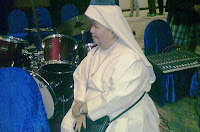


Saan baga naman nagpunta ang mga iyon...ay tutugtog na kami...

Mr. & Mrs. Dador (right) & with dotter Kay


Con-Gen Lamadrid with Mrs. Myrna Obiakor


Mabelle & son

Manoj, Beth & Hadiza


 The Filipinos in traditional and formal attires as befitting the celebration


Rosa must be very tired now
______________________________
A bird’s eyeview of the Philippine history: (Wikipedia)
50,000 years ago - Human fossil records indicate that the Philippines may have been inhabited
30,500 years ago - 22,000-year-old skull cap of a "Stone-Age" the oldest human fossil found in the Philippines discovered by Dr. Robert B. Fox, an American anthropologist of the National Museum, inside Tabon Cave, Palawan, on May 28, 1962 and dubbed the "Tabon Man". The Tabon caves of Palawan indicate settlement for at least; these hunter-gatherers used stone flake tools. After these early settlers, the Negrito arrived, whose ancestors include the Ati and the Aeta.
30,000 years ago - The History of the Philippines is believed to have begun with the arrival of the first humans via land bridges.
7th century to the beginning of the 1400s - numerous prosperous centers of trade had emerged, including the Kingdom of Namayan which flourished alongside Manila Bay, the Rajahnate of Cebu, the Confederation of Panay, the Rajahnate of Butuan, the Kingdom of Sanfotsi situated in Pangasinan, the Kingdoms of Zabag and Wak-Wak situated in Pampanga and Aparri (which specialized in trade with Japan and the Kingdom of Ryukyu in Okinawa).
900-1521 - official end of Philippine prehistory was in 900 AD, with the discovery of the Laguna Copperplate Inscription being the oldest known proof of literacy in the country, and the first marker for official written history.
10th century AD Several established kingdoms and sultanates present in the Philippines, such as the Buddhist Kingdom of Butuan, the indianized kingdoms of Tondo and Maysapan, the Muslim Sultanates of Sulu, Maynila, Maguindanao, and Lanao.
1200s The introduction of Islam
13th century Islam was firmly entrenched in the Sulu Archipelago and spread from there to Mindanao
1380 Karim ul' Makhdum, the first Islamic missionary reached and brought Islam to the Sulu Archipelago and Jolo
March 16, 1521 The first recorded visit from the West is the arrival of Ferdinand Magellan on Homonhon Island, southeast of Samar.
1543 Ruy López de Villalobos led an expedition to the islands and gave the name Las Islas Filipinas (after Philip II of Spain) to the islands of Samar and Leyte. The name would later be given to the entire archipelago.
1565 Islam faith reached Manila area
1565 Spanish colonization and settlement began with the arrival of Miguel López de Legazpi on the island of Cebu that lasted for more than three centuries
1571 Established a new town in Manila on the island of Luzon. Manila became the center of Spanish government, including military, religious, and commercial activities in the islands.
Spanish Settlement and Rule (1565-1898)
1565 to 1821 The Philippines was ruled as a territory of the Viceroyalty of New Spain and administered from Mexico City
September 24, 1762 Brigadier General William Draper and Rear-Admiral Samuel Cornish led British Army regulars and British East India Company soldiers, supported by the ships and men of the East Indies Squadron of the British Royal Navy captured Manila, "the greatest Spanish fortress in the western Pacific", and attempted to establish free trade with China
October 30, 1762 the British accepted the written surrender of the Spanish government in the Philippines from Archbishop Rojo and the Real Audiencia
March 20, 1764, the Spanish governor designate, Brigadier de la Torre, arrived at Santa Cruz, Manila, with packets from London and Madrid, including dispatches from London for the surrender of Manila to him. First week of April 1764 the British ended their rule by embarking from Manila and Cavite and sailing out of Manila Bay for Batavia, India, and England
1821 – 1898 ruled directly from Madrid, Spain
1863 Queen Isabella of Spain decreed the establishment of a public school system in Spanish, leading to increasing numbers of educated Filipinos.
1869 The opening of the Suez Canal cut travel time to Spain. Both of these events prompted the rise of the ilustrados, an enlightened class of Creoles and Indios, since many young Filipinos were able to study in Europe. Foremost was José Rizal, the most celebrated intellectual and radical illustrado of the era, wrote the novels "Noli Me Tangere", and "El filibusterismo", which greatly inspired the movement for independence
April 1896 First nationalist revolution in Asia - The Philippine Revolution against Spain. Rizal was implicated in the outbreak of the revolution and executed for treason the same year.
June 12, 1898 Philippine Declaration of Independence where Filipino revolutionary forces under General Emilio Aguinaldo (later to become the Philippines' first Republican President) proclaimed the sovereignty and independence of the Philippine Islands from the colonial rule of Spain after the latter was defeated at the Battle of Manila Bay during the Spanish-American War. The event saw the unfurling of the National Flag of the Philippines, made in Hong Kong by Mrs. Marcela Agoncillo, Lorenza Agoncillo and Delfina Herboza, and the performance of the Marcha Filipina Magdalo, as the Nation's National Anthem, now known as Lupang Hinirang, which was composed by Julian Felipe and played by the San Francisco de Malabon Marching band.
The June 12 proclamation was later modified by another Proclamation done at Malolos, Bulacan, upon the insistence of Apolinario Mabini, who objected to the Original proclamation, which essentially placed the Philippines under the protection of the United States.
1898 Treaty of Paris Spanish government ceded the Philippines to the United States in consideration for an indemnity for Spanish expenses and assets lost. Gen. Aguinaldo’s declaration was not recognized.
1899–1913 The first Philippine Republic rebelled against the U.S. occupation, resulting in the Philippine-American War.
February 4, 1899 two American privates on patrol killed three Filipino soldiers in San Juan, a Manila suburb, sparked the Philippine-American War
March 31, 1899 the capture of Malolos, the revolutionary capital
June 2, 1899 proclaimed a Declaration of War against the United States when at the end of the Spanish-American War, Spain transferred control of the Philippines to the United States. This agreement was not recognized by the Philippine Government.
1901 Phil. President Emilio Aguinaldo was captured and the Philippine-American War was declared over in 1902.
General Jacob H. Smith's infamous order "KILL EVERYONE OVER TEN" was the caption in the New York Journal cartoon on May 5, 1902. The Old Glory draped an American shield on which a vulture replaced the bald eagle. The bottom caption exclaimed, "Criminals Because They Were Born Ten Years Before We Took the Philippines."
1905 U.S. colonial rule of the Philippines started with very limited local rule.
May 14, 1935, a Filipino government, the constitution of which was framed and approved by Franklin D. Roosevelt (March 1935), was formed on the basis of principles similar to the U.S. Constitution. The established commonwealth elected Manuel L. Quezon as the president and featuring a very strong executive, a unicameral National Assembly, and a Supreme Court composed entirely of Filipinos for the first time since 1901, preparatory to a planned full independence from the United States in 1946, interrupted by the Japanese occupation of the islands during World War II.
December 8, 1941 Japan launched a surprise attack on the Clark Air Base in Pampanga, Philippines, just ten hours after the attack on Pearl Harbor
January 2, 1942 General MacArthur declared the capital city, Manila, an open city to prevent its destruction.
April 1942 and May 1942 Final surrender of United States-Philippine forces on the Bataan Peninsula and Corregidor in May of the same year. Most of the 80,000 prisoners of war captured by the Japanese at Bataan were forced to undertake the infamous Bataan Death March to a prison camp 105 kilometers to the north. It is estimated that about 10,000 Filipinos and 1,200 Americans died before reaching their destination
October 1943 Japanese - sponsored unpopular independent republic headed by Jose P.Laurel
October 20, 1944 MacArthur's Sixth United States Army landed on Leyte
September 2, 1945 Japan's formal surrender.
April 1946, Manuel Roxas the first president of the independent Republic of the Philippines
July 4, 1946 United States recognized Philippine independence in the Treaty of Manila
1947 A military assistance pact was signed in granting the United States a 99-year lease on designated military bases in the country (the lease was later reduced to 25 years beginning 1967).
April 1948 Pres. Roxas died suddenly of a heart attack and vice president, Elpidio Quirino, was elevated to the presidency. He ran for president in his own right in 1949, defeating Jose P. Laurel and winning a four-year term.
The Communist-supported Hukbalahap guerrillas (known as "Huks"), who had evolved into a violent resistance force against the new Philippine government. Government policy towards the Huks alternated between gestures of negotiation and harsh suppression. Secretary of Defense Ramon Magsaysay initiated a campaign to defeat the insurgents militarily and at the same time win popular support for the government.
1950s The Huk movement had waned
1953 Magsaysay was elected president on a populist platform promoting the resettlement of poor people in the Catholic north into traditionally Muslim areas.
May 1954 unconditional surrender of Huk leader Luis Taruc
March 1957 Ramon Magsaysay died in an airplane crash .
March 1957 Carlos P. Garcia succeeded to the presidency after Magsaysay's death, and was elected to a four-year term in the election of November that same year. His administration emphasized the nationalist theme of "Filipino first", arguing that the Filipino people should be given the chances to improve the country's economy. Garcia successfully negotiated for the United States' relinquishment of large military land reservations. However, his administration lost popularity on issues of government corruption as his term advanced.
1961 Diosdado Macapagal was elected president, defeating Garcia's re-election bid. Macapagal's foreign policy sought closer relations with neighboring Asian nations, particularly Malaya (later Malaysia) and Indonesia. Negotiations with the United States over base rights led to anti-American sentiment. Notably, the celebration of Independence Day was changed from July 4 to June 12, to honor the day that Emilio Aguinaldo declared independence from Spain in 1898.
1965 Macapagal was defeated by his former party-mate, Senate President Ferdinand Marcos, who had switched to the Nacionalista Party. Early in his presidency, Marcos initiated ambitious public works projects and intensified tax collection which brought the country economic prosperity throughout the 1970s. His administration built more roads (including a substantial portion of the Pan-Philippine Highway) than all his predecessors combined, and more schools than any previous administration.
1969 Marcos was re-elected president becoming the first president of the independent Philippines to achieve a second term. The Philippine Legislature was corrupt and impotent. His opponents blocked the necessary legislation to implement his ambitious plans and economic growth slowed. Crime and civil disobedience increased. The Communist Party of the Philippines formed the New People's Army. The Moro National Liberation Front continued to fight for an independent Muslim nation in Mindanao.
1970s The economy was robust, with budgetary and trade surpluses.
August 21, 1971 An explosion during the proclamation rally of the senatorial slate of the Liberal Party prompted Marcos to suspend the writ of habeas corpus, which he restored on January 11, 1972 after public protests.
1972 Declaration of martial law by President Ferdinand Marcos amidst the rising wave of lawlessness and the threat of a Communist insurgency, by virtue of Proclamation No. 1081. Marcos, ruling by decree, curtailed press freedom and other civil liberties, closed down Congress and media establishments, and ordered the arrest of opposition leaders and militant activists, including his staunchest critics senators Benigno Aquino, Jr., Jovito Salonga and Jose Diokno. The declaration of martial law was initially well received, given the social turmoil the Philippines was experiencing. Crime rates plunged dramatically after a curfew was implemented. Many political opponents were forced to go into exile. A "New Society" (Ang Bagong Lipunan) based on new social and political values is inculcated: the Gross National Product rose from P55 billion in 1972 to P193 billion in 1980. Tourism rose, contributing to the economy's growth.
1973 The new constitution went into effect (A constitutional convention, which had been called for in 1970 to replace the colonial 1935 Constitution, continued the work of framing a new constitution after the declaration of martial law) the changing of the form of government from presidential to parliamentary and allowing Marcos to stay in power beyond 1973.
January 17, 1981 Appeasing the Roman Catholic Church before the visit of Pope John Paul II,Marcos officially lifted martial law on retaining much of the government's power for arrest and detention. Corruption and nepotism as well as civil unrest contributed to a serious decline in economic growth and development under Marcos, whose health declined due to lupus.
1981 the political opposition boycotted the presidential elections which pitted Marcos against retired general Alejo Santos. Marcos won by a margin of over 16 million votes, which constitutionally allowed him to have another six-year term. Finance Minister Cesar Virata was elected as Prime Minister by the Batasang Pambansa.
1983, opposition leader Benigno Aquino, Jr. was assassinated at the Manila International Airport upon his return to the Philippines after a long period of exile. This coalesced popular dissatisfaction with Marcos and began a succession of events, including pressure from the United States, that culminated in a snap presidential election in February 1986. The opposition united under Aquino's widow, Corazon Aquino.
February 25, 1986 The peaceful and bloodless People Power Revolution brought about the ousting of Marcos and a return to democracy for the country. Installation of Corazon Aquino as president of the Philippines. The period since then, however, has been marked by political instability and hampered economic productivity.
February 1987 A new permanent constitution was ratified and enacted. The constitution crippled presidential power to declare martial law, proposed the creation of autonomous regions in the Cordilleras and Muslim Mindanao, and restored the presidential form of government and the bicameral Congress. Progress was made in revitalizing democratic institutions and respect for civil liberties, but Aquino's administration was also viewed as weak and fractious, and a return to full political stability and economic development was hampered by several attempted coups staged by disaffected members of the Philippine military.
December 1989 the most serious among the six unsuccessful coup attempts during the Aquino presidency
1991 eruption of Mount Pinatubo that left 700 dead and 200,000 homeless
1991, the Philippine Senate rejected a treaty that would have allowed a 10-year extension of the U.S. military bases in the country
1992 The United States turned over Clark Air Base in Pampanga to the government in November, and Subic Bay Naval Base in Zambales in December, ending almost a century of U.S. military presence in the Philippines.
1992 elections, Defense Secretary Fidel V. Ramos, endorsed by Aquino, won the presidency with just 23.6% of the vote in a field of seven candidates. Early in his administration, Ramos declared "national reconciliation" his highest priority and worked at building a coalition to overcome the divisiveness of the Aquino years. He legalized the Communist Party and laid the groundwork for talks with communist insurgents, Muslim separatists, and military rebels, attempting to convince them to cease their armed activities against the government.
June 1994, Ramos signed into law a general conditional amnesty covering all rebel groups, and Philippine military and police personnel accused of crimes committed while fighting the insurgents.
October 1995, the government signed an agreement bringing the military insurgency to an end. A peace agreement with the Moro National Liberation Front (MNLF), a major separatist group fighting for an independent homeland in Mindanao, was signed in 1996, ending the 24-year old struggle. However, an MNLF splinter group, the Moro Islamic Liberation Front continued the armed struggle for an Islamic state. Efforts by Ramos supporters to gain passage of an amendment that would allow him to run for a second term were met with large-scale protests, leading Ramos to declare he would not seek re-election.
1998 Joseph Estrada, a former movie actor who had served as Ramos' vice president, was elected president by a landslide victory. His election campaign pledged to help the poor and develop the country's agricultural sector. He enjoyed widespread popularity, particularly among the poor. Estrada assumed office amid the Asian Financial Crisis. The economy did, however, recovered from it. From a low -0.6% growth in 1998 to a moderate growth of 3.4% by 1999. Like his predecessor there was a similar attempt to change the 1987 constitution. The process is termed as CONCORD or Constitutional Correction for Development. Unlike Charter change under Ramos and Arroyo the CONCORD proposal, according to its proponents, would only amend the 'restrictive' economic provisions of the constitution that is considered as impeding the entry of more foreign investments in the Philippines. However it was not successful in amending the constitution.
March 21, 2000 President Estrada declared an "all-out-war" against the Moro Islamic Liberation Front (MILF) after the worsening secessionist movement in Midanao. The government later captured 46 MILF camps including the MILF's headquarters', Camp Abubakar.
October 2000 Estrada was accused of having accepted millions of pesos in payoffs from illegal gambling businesses; impeached by the House of Representatives, but his impeachment trial in the Senate broke down when the senate voted to block examination of the president's bank records.
January 20, 2001 In response, massive street protests erupted demanding Estrada's resignation. Faced with street protests, cabinet resignations, and a withdrawal of support from the armed forces, Estrada was forced out from office; Vice President Gloria Macapagal-Arroyo (the daughter of the late President Diosdado Macapagal) was sworn in as Estrada's successor on the day of his departure. Her accession to power was further legitimized by the mid-term congressional and local elections held four months later, when her coalition won an overwhelming victory.
December 2002 Arroyo declared that she would not run in the May 2004 presidential election
July 2003 Arroyo's initial term in office was marked by fractious coalition politics as well as a military mutiny in Manila that led her to declare a month-long nationwide state of rebellion.
October 2003, Arroyo reversed herself and decided to join the race; re-elected and sworn in for her own six-year term as president on June 30, 2004.
2005, a tape of a wiretapped conversation surfaced bearing the voice of Arroyo apparently asking an election official if her margin of victory could be maintained. The tape sparked protests calling for Arroyo's resignation. Arroyo admitted to inappropriately speaking to an election official, but denied allegations of fraud and refused to step down. Attempts to impeach the president failed later that year.
Arroyo currently spearheads a controversial plan for an overhaul of the constitution to transform the present presidential-bicameral republic into a federal parliamentary-unicameral form of government.
Rosa with Indonesian Consul Walther S. Kariodimedjo


Mr. & Mrs. Dador (right) & with dotter Kay


Con-Gen Lamadrid with Mrs. Myrna Obiakor


Mabelle & son


Sherwin, Benjie & JT
Bernie & Maris (June 11 is his birthday, too - as we celebrated the Independence Day)


Maris, Esper, Bernie & Myrna


Ampy & Maris

JT & guest


Maris, Esper, Bernie & Myrna


Ampy & Maris


JT & guest
& Maris & Jason


UNICEM (Calabar)
 Hope of the Fatherland....
Mercado family


UNICEM (Calabar)
 Hope of the Fatherland....
Mercado family


GRAND REUNION circa 2003
The Filipinos in traditional and formal attires as befitting the celebration


Rosa must be very tired now
______________________________
A bird’s eyeview of the Philippine history: (Wikipedia)
50,000 years ago - Human fossil records indicate that the Philippines may have been inhabited
30,500 years ago - 22,000-year-old skull cap of a "Stone-Age" the oldest human fossil found in the Philippines discovered by Dr. Robert B. Fox, an American anthropologist of the National Museum, inside Tabon Cave, Palawan, on May 28, 1962 and dubbed the "Tabon Man". The Tabon caves of Palawan indicate settlement for at least; these hunter-gatherers used stone flake tools. After these early settlers, the Negrito arrived, whose ancestors include the Ati and the Aeta.
30,000 years ago - The History of the Philippines is believed to have begun with the arrival of the first humans via land bridges.
7th century to the beginning of the 1400s - numerous prosperous centers of trade had emerged, including the Kingdom of Namayan which flourished alongside Manila Bay, the Rajahnate of Cebu, the Confederation of Panay, the Rajahnate of Butuan, the Kingdom of Sanfotsi situated in Pangasinan, the Kingdoms of Zabag and Wak-Wak situated in Pampanga and Aparri (which specialized in trade with Japan and the Kingdom of Ryukyu in Okinawa).
900-1521 - official end of Philippine prehistory was in 900 AD, with the discovery of the Laguna Copperplate Inscription being the oldest known proof of literacy in the country, and the first marker for official written history.
10th century AD Several established kingdoms and sultanates present in the Philippines, such as the Buddhist Kingdom of Butuan, the indianized kingdoms of Tondo and Maysapan, the Muslim Sultanates of Sulu, Maynila, Maguindanao, and Lanao.
1200s The introduction of Islam
13th century Islam was firmly entrenched in the Sulu Archipelago and spread from there to Mindanao
1380 Karim ul' Makhdum, the first Islamic missionary reached and brought Islam to the Sulu Archipelago and Jolo
March 16, 1521 The first recorded visit from the West is the arrival of Ferdinand Magellan on Homonhon Island, southeast of Samar.
1543 Ruy López de Villalobos led an expedition to the islands and gave the name Las Islas Filipinas (after Philip II of Spain) to the islands of Samar and Leyte. The name would later be given to the entire archipelago.
1565 Islam faith reached Manila area
1565 Spanish colonization and settlement began with the arrival of Miguel López de Legazpi on the island of Cebu that lasted for more than three centuries
1571 Established a new town in Manila on the island of Luzon. Manila became the center of Spanish government, including military, religious, and commercial activities in the islands.
Spanish Settlement and Rule (1565-1898)
1565 to 1821 The Philippines was ruled as a territory of the Viceroyalty of New Spain and administered from Mexico City
September 24, 1762 Brigadier General William Draper and Rear-Admiral Samuel Cornish led British Army regulars and British East India Company soldiers, supported by the ships and men of the East Indies Squadron of the British Royal Navy captured Manila, "the greatest Spanish fortress in the western Pacific", and attempted to establish free trade with China
October 30, 1762 the British accepted the written surrender of the Spanish government in the Philippines from Archbishop Rojo and the Real Audiencia
March 20, 1764, the Spanish governor designate, Brigadier de la Torre, arrived at Santa Cruz, Manila, with packets from London and Madrid, including dispatches from London for the surrender of Manila to him. First week of April 1764 the British ended their rule by embarking from Manila and Cavite and sailing out of Manila Bay for Batavia, India, and England
1821 – 1898 ruled directly from Madrid, Spain
1863 Queen Isabella of Spain decreed the establishment of a public school system in Spanish, leading to increasing numbers of educated Filipinos.
1869 The opening of the Suez Canal cut travel time to Spain. Both of these events prompted the rise of the ilustrados, an enlightened class of Creoles and Indios, since many young Filipinos were able to study in Europe. Foremost was José Rizal, the most celebrated intellectual and radical illustrado of the era, wrote the novels "Noli Me Tangere", and "El filibusterismo", which greatly inspired the movement for independence
April 1896 First nationalist revolution in Asia - The Philippine Revolution against Spain. Rizal was implicated in the outbreak of the revolution and executed for treason the same year.
June 12, 1898 Philippine Declaration of Independence where Filipino revolutionary forces under General Emilio Aguinaldo (later to become the Philippines' first Republican President) proclaimed the sovereignty and independence of the Philippine Islands from the colonial rule of Spain after the latter was defeated at the Battle of Manila Bay during the Spanish-American War. The event saw the unfurling of the National Flag of the Philippines, made in Hong Kong by Mrs. Marcela Agoncillo, Lorenza Agoncillo and Delfina Herboza, and the performance of the Marcha Filipina Magdalo, as the Nation's National Anthem, now known as Lupang Hinirang, which was composed by Julian Felipe and played by the San Francisco de Malabon Marching band.
The June 12 proclamation was later modified by another Proclamation done at Malolos, Bulacan, upon the insistence of Apolinario Mabini, who objected to the Original proclamation, which essentially placed the Philippines under the protection of the United States.
1898 Treaty of Paris Spanish government ceded the Philippines to the United States in consideration for an indemnity for Spanish expenses and assets lost. Gen. Aguinaldo’s declaration was not recognized.
1899–1913 The first Philippine Republic rebelled against the U.S. occupation, resulting in the Philippine-American War.
February 4, 1899 two American privates on patrol killed three Filipino soldiers in San Juan, a Manila suburb, sparked the Philippine-American War
March 31, 1899 the capture of Malolos, the revolutionary capital
June 2, 1899 proclaimed a Declaration of War against the United States when at the end of the Spanish-American War, Spain transferred control of the Philippines to the United States. This agreement was not recognized by the Philippine Government.
1901 Phil. President Emilio Aguinaldo was captured and the Philippine-American War was declared over in 1902.
General Jacob H. Smith's infamous order "KILL EVERYONE OVER TEN" was the caption in the New York Journal cartoon on May 5, 1902. The Old Glory draped an American shield on which a vulture replaced the bald eagle. The bottom caption exclaimed, "Criminals Because They Were Born Ten Years Before We Took the Philippines."
1905 U.S. colonial rule of the Philippines started with very limited local rule.
May 14, 1935, a Filipino government, the constitution of which was framed and approved by Franklin D. Roosevelt (March 1935), was formed on the basis of principles similar to the U.S. Constitution. The established commonwealth elected Manuel L. Quezon as the president and featuring a very strong executive, a unicameral National Assembly, and a Supreme Court composed entirely of Filipinos for the first time since 1901, preparatory to a planned full independence from the United States in 1946, interrupted by the Japanese occupation of the islands during World War II.
December 8, 1941 Japan launched a surprise attack on the Clark Air Base in Pampanga, Philippines, just ten hours after the attack on Pearl Harbor
January 2, 1942 General MacArthur declared the capital city, Manila, an open city to prevent its destruction.
April 1942 and May 1942 Final surrender of United States-Philippine forces on the Bataan Peninsula and Corregidor in May of the same year. Most of the 80,000 prisoners of war captured by the Japanese at Bataan were forced to undertake the infamous Bataan Death March to a prison camp 105 kilometers to the north. It is estimated that about 10,000 Filipinos and 1,200 Americans died before reaching their destination
October 1943 Japanese - sponsored unpopular independent republic headed by Jose P.Laurel
October 20, 1944 MacArthur's Sixth United States Army landed on Leyte
September 2, 1945 Japan's formal surrender.
April 1946, Manuel Roxas the first president of the independent Republic of the Philippines
July 4, 1946 United States recognized Philippine independence in the Treaty of Manila
1947 A military assistance pact was signed in granting the United States a 99-year lease on designated military bases in the country (the lease was later reduced to 25 years beginning 1967).
April 1948 Pres. Roxas died suddenly of a heart attack and vice president, Elpidio Quirino, was elevated to the presidency. He ran for president in his own right in 1949, defeating Jose P. Laurel and winning a four-year term.
The Communist-supported Hukbalahap guerrillas (known as "Huks"), who had evolved into a violent resistance force against the new Philippine government. Government policy towards the Huks alternated between gestures of negotiation and harsh suppression. Secretary of Defense Ramon Magsaysay initiated a campaign to defeat the insurgents militarily and at the same time win popular support for the government.
1950s The Huk movement had waned
1953 Magsaysay was elected president on a populist platform promoting the resettlement of poor people in the Catholic north into traditionally Muslim areas.
May 1954 unconditional surrender of Huk leader Luis Taruc
March 1957 Ramon Magsaysay died in an airplane crash .
March 1957 Carlos P. Garcia succeeded to the presidency after Magsaysay's death, and was elected to a four-year term in the election of November that same year. His administration emphasized the nationalist theme of "Filipino first", arguing that the Filipino people should be given the chances to improve the country's economy. Garcia successfully negotiated for the United States' relinquishment of large military land reservations. However, his administration lost popularity on issues of government corruption as his term advanced.
1961 Diosdado Macapagal was elected president, defeating Garcia's re-election bid. Macapagal's foreign policy sought closer relations with neighboring Asian nations, particularly Malaya (later Malaysia) and Indonesia. Negotiations with the United States over base rights led to anti-American sentiment. Notably, the celebration of Independence Day was changed from July 4 to June 12, to honor the day that Emilio Aguinaldo declared independence from Spain in 1898.
1965 Macapagal was defeated by his former party-mate, Senate President Ferdinand Marcos, who had switched to the Nacionalista Party. Early in his presidency, Marcos initiated ambitious public works projects and intensified tax collection which brought the country economic prosperity throughout the 1970s. His administration built more roads (including a substantial portion of the Pan-Philippine Highway) than all his predecessors combined, and more schools than any previous administration.
1969 Marcos was re-elected president becoming the first president of the independent Philippines to achieve a second term. The Philippine Legislature was corrupt and impotent. His opponents blocked the necessary legislation to implement his ambitious plans and economic growth slowed. Crime and civil disobedience increased. The Communist Party of the Philippines formed the New People's Army. The Moro National Liberation Front continued to fight for an independent Muslim nation in Mindanao.
1970s The economy was robust, with budgetary and trade surpluses.
August 21, 1971 An explosion during the proclamation rally of the senatorial slate of the Liberal Party prompted Marcos to suspend the writ of habeas corpus, which he restored on January 11, 1972 after public protests.
1972 Declaration of martial law by President Ferdinand Marcos amidst the rising wave of lawlessness and the threat of a Communist insurgency, by virtue of Proclamation No. 1081. Marcos, ruling by decree, curtailed press freedom and other civil liberties, closed down Congress and media establishments, and ordered the arrest of opposition leaders and militant activists, including his staunchest critics senators Benigno Aquino, Jr., Jovito Salonga and Jose Diokno. The declaration of martial law was initially well received, given the social turmoil the Philippines was experiencing. Crime rates plunged dramatically after a curfew was implemented. Many political opponents were forced to go into exile. A "New Society" (Ang Bagong Lipunan) based on new social and political values is inculcated: the Gross National Product rose from P55 billion in 1972 to P193 billion in 1980. Tourism rose, contributing to the economy's growth.
1973 The new constitution went into effect (A constitutional convention, which had been called for in 1970 to replace the colonial 1935 Constitution, continued the work of framing a new constitution after the declaration of martial law) the changing of the form of government from presidential to parliamentary and allowing Marcos to stay in power beyond 1973.
January 17, 1981 Appeasing the Roman Catholic Church before the visit of Pope John Paul II,Marcos officially lifted martial law on retaining much of the government's power for arrest and detention. Corruption and nepotism as well as civil unrest contributed to a serious decline in economic growth and development under Marcos, whose health declined due to lupus.
1981 the political opposition boycotted the presidential elections which pitted Marcos against retired general Alejo Santos. Marcos won by a margin of over 16 million votes, which constitutionally allowed him to have another six-year term. Finance Minister Cesar Virata was elected as Prime Minister by the Batasang Pambansa.
1983, opposition leader Benigno Aquino, Jr. was assassinated at the Manila International Airport upon his return to the Philippines after a long period of exile. This coalesced popular dissatisfaction with Marcos and began a succession of events, including pressure from the United States, that culminated in a snap presidential election in February 1986. The opposition united under Aquino's widow, Corazon Aquino.
February 25, 1986 The peaceful and bloodless People Power Revolution brought about the ousting of Marcos and a return to democracy for the country. Installation of Corazon Aquino as president of the Philippines. The period since then, however, has been marked by political instability and hampered economic productivity.
February 1987 A new permanent constitution was ratified and enacted. The constitution crippled presidential power to declare martial law, proposed the creation of autonomous regions in the Cordilleras and Muslim Mindanao, and restored the presidential form of government and the bicameral Congress. Progress was made in revitalizing democratic institutions and respect for civil liberties, but Aquino's administration was also viewed as weak and fractious, and a return to full political stability and economic development was hampered by several attempted coups staged by disaffected members of the Philippine military.
December 1989 the most serious among the six unsuccessful coup attempts during the Aquino presidency
1991 eruption of Mount Pinatubo that left 700 dead and 200,000 homeless
1991, the Philippine Senate rejected a treaty that would have allowed a 10-year extension of the U.S. military bases in the country
1992 The United States turned over Clark Air Base in Pampanga to the government in November, and Subic Bay Naval Base in Zambales in December, ending almost a century of U.S. military presence in the Philippines.
1992 elections, Defense Secretary Fidel V. Ramos, endorsed by Aquino, won the presidency with just 23.6% of the vote in a field of seven candidates. Early in his administration, Ramos declared "national reconciliation" his highest priority and worked at building a coalition to overcome the divisiveness of the Aquino years. He legalized the Communist Party and laid the groundwork for talks with communist insurgents, Muslim separatists, and military rebels, attempting to convince them to cease their armed activities against the government.
June 1994, Ramos signed into law a general conditional amnesty covering all rebel groups, and Philippine military and police personnel accused of crimes committed while fighting the insurgents.
October 1995, the government signed an agreement bringing the military insurgency to an end. A peace agreement with the Moro National Liberation Front (MNLF), a major separatist group fighting for an independent homeland in Mindanao, was signed in 1996, ending the 24-year old struggle. However, an MNLF splinter group, the Moro Islamic Liberation Front continued the armed struggle for an Islamic state. Efforts by Ramos supporters to gain passage of an amendment that would allow him to run for a second term were met with large-scale protests, leading Ramos to declare he would not seek re-election.
1998 Joseph Estrada, a former movie actor who had served as Ramos' vice president, was elected president by a landslide victory. His election campaign pledged to help the poor and develop the country's agricultural sector. He enjoyed widespread popularity, particularly among the poor. Estrada assumed office amid the Asian Financial Crisis. The economy did, however, recovered from it. From a low -0.6% growth in 1998 to a moderate growth of 3.4% by 1999. Like his predecessor there was a similar attempt to change the 1987 constitution. The process is termed as CONCORD or Constitutional Correction for Development. Unlike Charter change under Ramos and Arroyo the CONCORD proposal, according to its proponents, would only amend the 'restrictive' economic provisions of the constitution that is considered as impeding the entry of more foreign investments in the Philippines. However it was not successful in amending the constitution.
March 21, 2000 President Estrada declared an "all-out-war" against the Moro Islamic Liberation Front (MILF) after the worsening secessionist movement in Midanao. The government later captured 46 MILF camps including the MILF's headquarters', Camp Abubakar.
October 2000 Estrada was accused of having accepted millions of pesos in payoffs from illegal gambling businesses; impeached by the House of Representatives, but his impeachment trial in the Senate broke down when the senate voted to block examination of the president's bank records.
January 20, 2001 In response, massive street protests erupted demanding Estrada's resignation. Faced with street protests, cabinet resignations, and a withdrawal of support from the armed forces, Estrada was forced out from office; Vice President Gloria Macapagal-Arroyo (the daughter of the late President Diosdado Macapagal) was sworn in as Estrada's successor on the day of his departure. Her accession to power was further legitimized by the mid-term congressional and local elections held four months later, when her coalition won an overwhelming victory.
December 2002 Arroyo declared that she would not run in the May 2004 presidential election
July 2003 Arroyo's initial term in office was marked by fractious coalition politics as well as a military mutiny in Manila that led her to declare a month-long nationwide state of rebellion.
October 2003, Arroyo reversed herself and decided to join the race; re-elected and sworn in for her own six-year term as president on June 30, 2004.
2005, a tape of a wiretapped conversation surfaced bearing the voice of Arroyo apparently asking an election official if her margin of victory could be maintained. The tape sparked protests calling for Arroyo's resignation. Arroyo admitted to inappropriately speaking to an election official, but denied allegations of fraud and refused to step down. Attempts to impeach the president failed later that year.
Arroyo currently spearheads a controversial plan for an overhaul of the constitution to transform the present presidential-bicameral republic into a federal parliamentary-unicameral form of government.


 Posts
Posts


